Thursday, August 28, 2014
TINY: A Story About Living Small
This week I finally had the opportunity to see the movie TINY: A Story About Living Small, which is now available on Netflix and iTunes. I saw the preview last year at the SF Green Film Fest so I fully realized this film is not a how-to manual for us tiny home enthusiasts. It is, however, a good introduction to tiny homes as it looks at some of the trials and tribulations one couple experiences as they build their own tiny home. The film also has a number of brief interviews with thought leaders such as Jay Shafer, Dee Williams, Tammy Strobel, and others. I highly recommend this film to anyone with a remote interest in tiny homes, as well as friends and family of anyone, like me, who seems hopelessly obsessed with tiny homes.

Thursday, October 17, 2013
Glass cabin retreat
Not only are professionally-made tiny home videos entertaining to watch, but I believe they also help "spread the message" to a wider audience who may be initially drawn to the narrative behind the building rather than the structure itself. One of the things I particularly enjoyed about this story is how during their travels they continuously searched for the perfect (reclaimed) windows, each of which has its own story.
As for the cabin itself, I'm intrigued by their extensive use of glass. One of the biggest advantages is all that glass will make it feel like you're outside in the woods even when you're inside the cabin. They'll get plenty of natural light, as well as a myriad of interesting light patterns as the sun rises and sets each day. There also should be plenty of solar heat gain (assuming windows are oriented properly), reducing or eliminating the need for electricity and/or gas for heat. Furthermore, single-paned windows like these can be obtained very inexpensively (their cabin was built for ~$500) as home owners replace them with more energy efficient windows.
While it's great as a retreat, which it apparently is, or an artist/yoga studio, a structure with so much glass may not be ideal as a primary home as it can frequently be too hot (excessive solar gain) or too cold (heat loss through conduction, convection, and radiation). While awnings, shades, and curtains can help control solar gain, reducing heat loss in such a structure, especially with inefficient single-paned windows, can be challenging. One solution might be to install some type of thermal mass inside the cabin, like a Trombe Wall, which absorbs heat (solar radiation) during the day and then slowly releases that heat throughout the night.
Sidebar: This video is actually part of the interesting "Half Cut Tea" series of mini-documentaries on a variety of different artists.
Saturday, September 28, 2013
Tiny Snapshot: Little Free Library

Wednesday, August 14, 2013
Lodges and privies along Vermont's Long Trail
 |
| Butler Lodge |
 |
| Taft Lodge interior with community table and drying backpacking gear |
Earlier this month I was fortunate to spend ten days in Vermont with friends backpacking a couple of sections (Mt. Mansfield & Camel's Hump) of the historic Long Trail. While the peaks may seem tame by Pacific Coast standards (Mt. Mansfield's peak is ~4393 ft, the highest point in VT) the trail is fairly challenging with ladders and rock scrambles requiring use of hands. When it rains the water courses down the trail making it difficult to get solid traction on the rocks. Still, the natural beauty, including alpine tundra, and amazing 360 degree ridge views of Lake Champlain and the White and Adirondack Mountains make it well worth the effort.
The Long Trail, which traverses Vermont's length, is the oldest long distance trail in the United States. The non-profit Green Mountain Club (GMC) started developing the trail in 1910 and still maintains it today. In addition to the trail itself, the GMC manages a set of rustic lodges and composting privies that hikers, as well as skiers and snowshoers in the winter, can utilize. The lodges we stayed in were generally constructed early in the trail's history and more recently renovated. They're small and lack plumbing and electricity, but are actually quite comfortable. The lodges all had lofts and could accommodate far more people than you would imagine: as more hikers show up everyone just squeezes in to make room like a cozy clubhouse in the woods. It's great to meet and talk with different hikers before everyone goes to sleep or heads to their next destination in the morning.
The composting privies were surprisingly clean and odor-free. I attribute this to many years of experience under the GMC's belt, dedicated caretakers, and a knowledgeable, respectful user base. The relatively simple structures admit fresh air and natural light while still providing sufficient privacy. Bark mulch is provided as a cover material to reduce odors, absorb liquids, and contribute carbon to the composting process. The biggest challenge is apparently the excess moisture from urine. Hikers are encouraged to urinate in the woods instead of the privy, but some seemingly prefer to take care of all their business in one sitting (so to speak).
 |
| Taft Lodge. Note historically consistent, accident-provoking size of door |
 |
| Jake, a Taft Lodge caretaker, manages back office operations at his sturdy composting privy |
 |
| Hump Brook composting privy |
 |
| Privy interior: plenty of natural light and convenient, locally-sourced seat backstop |
 |
| Long Trail: view from Mt. Mansfield summit |
Thursday, July 18, 2013
Tiny surfing tender at Mollusk

Wednesday, May 29, 2013

Thursday, May 23, 2013
Outdoor screening of TINY in downtown San Francisco

I was selfishly hoping the movie would be a how-to about building a tiny home, but that probably wouldn't appeal to the general public. Instead, it's an interesting look at the ups and downs of building and living in a tiny home as well as brief interviews with a variety of people involved in tiny homes. It's actually a great introduction to tiny homes for anyone either unfamiliar or just starting to consider them. The screening even concluded with a Sundance-style panel discussion where the filmmakers along with Jay Shafer answered audience questions.
 |
| Filmmakers and tiny home builders Christopher Smith & Merete Mueller with SolMan solar generator to the left |
Monday, April 8, 2013
"Tiny Cabin, Giant View"
I'm fortunate that both my parents continue to clip out and send me interesting articles from the various publications they read. I particularly enjoyed a recent Wall Street Journal article about a tiny, idyllic cabin in the Sierra Nevada mountains outside Tahoe. Snowboarder Mike Basich built his home from granite stones and wood he collected from his property and milled himself. The off-grid cabin, which is several miles from the road, also boasts a fire-heated hot tub and his own personal ski lift. Impressive and inspiring!
Friday, April 5, 2013
Tiny Snapshot

Sunday, March 10, 2013
Tiny home goes skiing
Outdoor Research and others sponsor extreme skiers Molly Baker and Zack Giffin and helped produce this video as well as well as the Tiny House Tour episodes. Fortunately, the commercialization is relatively subtle. Actually, I think it's great to see a reputable company like OR indirectly promote tiny homes on their home page even if the end goal is simply to sell more clothing and gear. Design decisions may have been informed by the tiny home's role as a maximum-occupancy ski hut and branding opportunity. Curiously, there is no bathroom or shower, but that may be because they needed the space to accommodate five adults (cameramen included). The beautiful little wood-burning stove is probably great for drying ski gear, but the stove's footprint, including clearance from the walls, can make it impractical for many tiny home owners. The element I particularly like, though, is the unique stairs going to the loft. The woodwork is magnificent, yet the stairs are simple, sleek and keep the room open instead of acting as a barrier. The stairs look like they function effectively as seats or temporary spots for gear or drinks.
Sidebar: Warren Miller was a pioneer of documentary ski films starting with Deep and Light in 1949. He produced, directed and narrated his films until 1988 and remained involved until 2004. Interestingly, he got his start in the 1940's while living in a trailer at a ski resort (Sun Valley) parking lot, not unlike Molly and Zack.
Tuesday, February 12, 2013
Plastic bag bans, health, and the environment

I was very proud when San Francisco in 2007 became one of the first major cities to ban plastic checkout bags. Lightweight and durable, they're almost irresistibly convenient, but these same characteristics make single-use plastic bags so pernicious in marine environments where they persist beyond our lifetimes, traveling currents and endangering marine life. Reusable grocery bags seem like a no-brainer, but continuing buzz based on a couple of university studies now has us concerned reusable bags harbor potentially harmful bacteria. Let's forget the questionable methodology and conflict of interests (one study was funded by the plastic-bag-friendly American Chemistry Council), and assume reusable grocery bags, like just about anything that touches food, can potentially harbor bacteria. Fortunately, it's actually fairly simple to eliminate any threat freeloading bacteria might pose through cleaning (by hand or machine) or by simply letting the inside out bag sit in the sun for a few hours.
While bacteria can generally be managed with a dollop of vigilance, the reusable bag proposition becomes more complex when you consider their production. For example, cotton bags may be biodegradable, but their production requires resource-intensive cotton: an interesting British study found that cotton bags require 131 uses to equal the global warming impact of conventional plastic bags. Repurposing containers as grocery bags is the ideal. The truly committed can even knit their own reusable bag from discarded plastic bags. The bottom line is we should consider the entire life-cycle of reusable bags including production, use/cleaning, and disposal. Beyond that it's a matter of personal preferences and habits: if it's easier to store and bring a certain type of bag on a consistent basis then it's probably a good choice.
Thursday, January 17, 2013
BioLite stoves
 |
| BioLite Campstove |
I'm always interested in camping equipment innovations which reduce weight/size, increase efficacy, and/or eliminate the need for other equipment. While I'm not one of those guys always sporting the "latest and greatest" equipment, I do focus on significant technology improvements. Recently I've become intrigued with the BioLite CampStove which burns wood efficiently (with the help of an integrated fan), and converts thermal energy to electricity to power the fan as well as charge small electronics like cell phones. In addition, the CampStove technology and funds from CampStove purchases enable the company to provide those in developing nations currently cooking with unhealthy open fires with a cleaner, low-cost, electricity-generating cook-stove, the BioLite HomeStove.
Gas camp stoves can be convenient, but the gas canisters are bulky, bad for the environment, and must be purchased at stores. Wood burning stoves are lighter and more sustainable. There are wood burning camp stoves that are less expensive than the $129 CampStove and lighter (~5-10oz vs. 33oz), but they require you to blow into the stove fire constantly thereby breathing in acrid smoke. Not pleasant. If the CampStove's fan works as it should then it will stoke the fire for you, and require less wood gathering since the combustion is more efficient (YouTube reviews). The thermoelectric generator converts heat into electricity not only to run the fan, but to charge small electronics. That's great for emergencies like Hurricane Sandy, but I leave electronics behind when I'm camping. I hope to see BioLite offer a similar but lighter, less expensive power module that removes the USB charging components.
The technology along with capital from sales of CampStoves enable BioLite to provide low-cost HomeStoves to developing countries. This social entrepreneurship could significantly help billions of people who daily gather wood and cook over open fires, inhaling smoke and carbon monoxide from incomplete combustion. The HomeStove, which is in pilot programs around the world, could reduce wood required as well as emitted smoke and CO while charging cell phones or small lights (very important in rural off-grid villages). It's still early, but the impact HomeStoves have across the globe could be monumental.
 |
| BioLite HomeStove |
Wednesday, December 5, 2012
Design Elements: China random
 |
| Roof corner of imperial building in Forbidden City (Beijing) |
 |
| Forbidden City (Beijing) |
 |
| IBM tower (Beijing) |
 |
| Long Corridor, Summer Palace (Beijing) |
 |
| Long Corridor, Summer Palace (Beijing) |
 |
| Summer Palace (Beijing) |
 |
| Beijing |
 |
| Xi'an |
 |
| Door hinge (Hangzhou) |
 |
| Dragon wall, Yu Garden (Shanghai) |
 |
| Jing'an Temple (Shanghai) |
 |
| Jing'an Temple (Shanghai) |
 |
| Shibaozhai Pagoda (Zhong County) |
 |
| Shibaozhai Pagoda (Zhong County) |
 |
| 3-wheeler in Yangshuo |
 |
| Hong Kong Island |
Tuesday, December 4, 2012
Housing in China
 |
| Fengjing (Shanghai) |
One of the advantages of utilizing a tour company for a trip like this is you get to see and experience a great deal in a relatively short time period. Another advantage is the interesting "cultural connections" where we could meet local residents in their own homes, which were often comprised of just two or three small rooms. To be sure, many of these people were older and retired which, of course, gives them time to entertain inquisitive Americans. They seem generally happy with their homes because they are part of long-standing, tightly-woven communities. Many others, however, live in high rise apartment towers (a seemingly infinite number of which are currently being built) which provide more space and modern conveniences, but also sacrifice some of the community aspects. Many of the younger people with whom we spoke lived in these apartments with three or more generations of their family.
Of course, China is a very large and varied country, and I would expect to see different housing solutions in different regions. In the city of Hangzhou with its idyllic West Lake, we saw many multi-story, detached homes. After visiting a tea farm in the area, we had lunch with a farmer's family in one of these homes. The farmer indicated that he, like many others in the region, lived on one floor with his family and rented out the rooms on the floor above them. Whether it's an older two-room home in a village, an apartment in a ubiquitous high rise, or a multi-story home in prosperous Hangzhou, very little space is unused and idle in the Chinese home.
 |
| Fengjing |
 |
| Beijing hutong |
 |
| Xi'an: Just a few of the many high rise buildings under construction |
 |
| Yangtze River: Three Gorges Dam forced many locals to relocate to apartments on higher ground |
 |
| Smiling residents in Fengjing |
Friday, November 30, 2012
Tough call for Drakes Bay Oyster Company
 |
| Drakes Estero |
The company has been operating for nearly 80 years and employs 30 people with seven families living on the property. While the Pacific oysters they raise are non-native, they are, like all oysters, filter feeders who remove pollutants and improve water quality. Ironically, Ken Salazar, Secretary of the Interior, wants the NPS to give dairy farms at Point Reyes multi-year lease extensions. While these farms are also historic, their environmental impact is certainly greater than the oyster farm's. Unfortunately, the oyster farm environmental impact statement utilized NPS reports which, according to the National Academy of Sciences, were flawed and biased. The Park Service does many great things for which I am very grateful, but it appears in this instance they may have acted in a heavy-handed manner.
Maybe I'm naive, but it seems like one compromise might have been a restriction of only native oysters and non-motorized boats in Drakes Estero. This very well might be unacceptable to Drakes Bay Oyster Company, but at least it would give them an option instead of being forced to move out in 90 days.
Tuesday, October 23, 2012
Ella and Little Yellow
 |
| Little Yellow with Ella securing the stairs |
- Use of natural wood. The first thing you notice is the interesting branch that serves as the corner post (purely aesthetic) near the door. The interior also features natural wood in places such as the coat rack and bench legs.
- The kitchen counter, which she had done professionally, is spectacular. The interesting grain patterns and natural, biomorphic edge turn a kitchen counter into an objet d'art. I definitely see the merits of having a professional complete certain focal aspects of a tiny home.
- Custom trim work. Ella cut attractive designs in the trim which seem to automatically draw the eyes.
- The shower is a converted livestock trough: significantly less expensive with more character than a traditional shower. I assume it also can be used as an old-school bathtub.
In Soquel several people asked Ella what she was selling or which company she represented. She indicated she wasn't selling anything and she scheduled open houses simply because she knew many people were interested in tiny homes. I'm certain I'm not the only one who is both grateful and inspired.
 |
| Beautiful kitchen counter |
 |
| Livestock trough becomes shower |
 |
| Traditional Fencl loft |
 |
| Natural wood, custom trim |
Tuesday, October 16, 2012
Tiny mobile home at Fleet Week

Wednesday, October 10, 2012
Hardly Strictly Bluegrass
 |
| Ralph Stanley and The Clinch Mountain Boys play the Banjo Stage last Sunday |
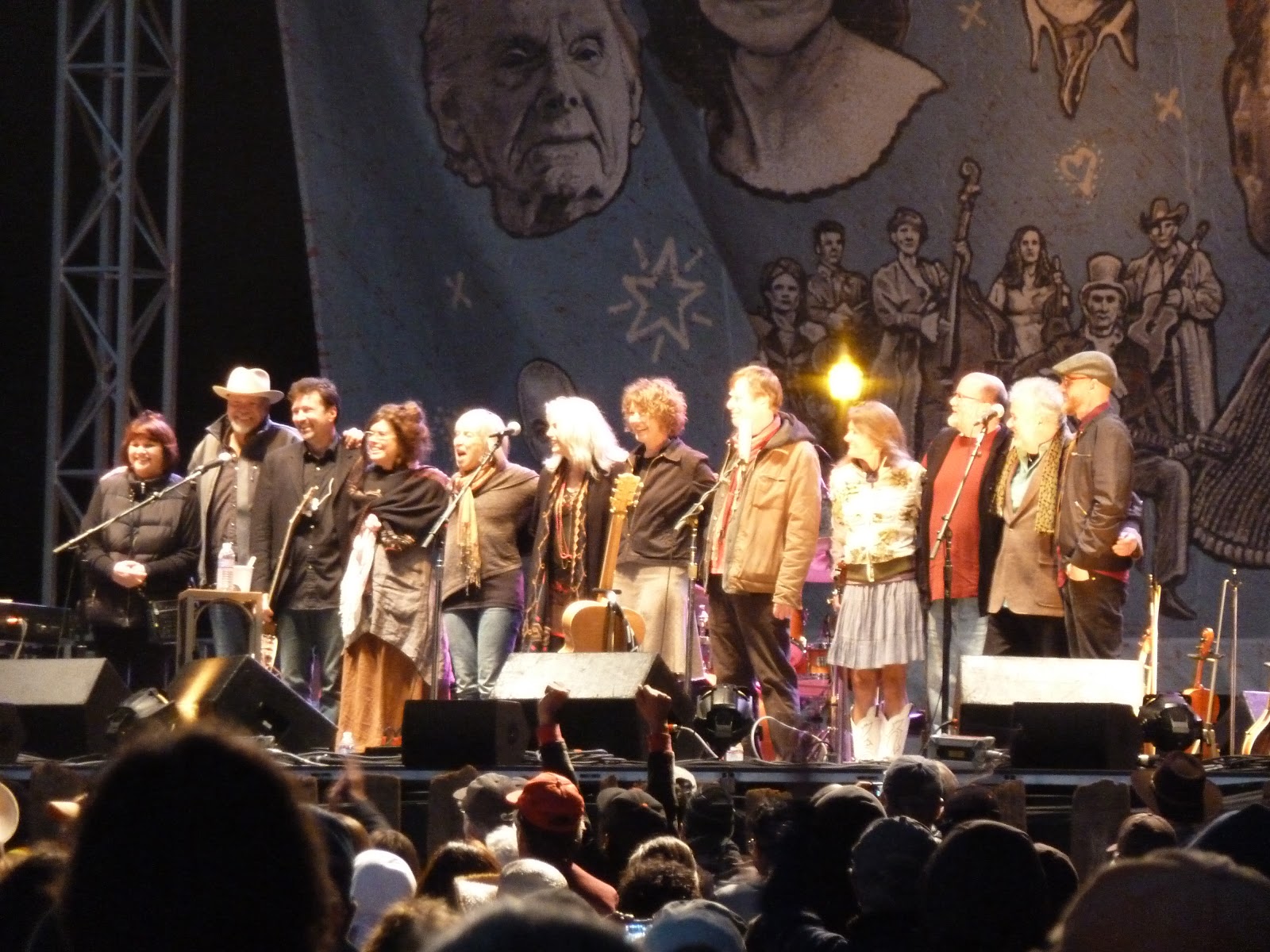
If you live in the SF Bay Area you are probably familiar with Hardly Strictly Bluegrass, the 3-day, multi-stage, free music festival in Golden Gate Park. Many locals avoid it because of the enormous crowds, but I'm still a devout fan. The HSB lineup (list of scheduled musicians) is always amazing and there are frequently difficult decisions with six different stages. The musicians themselves generally seem happy to be there and often play together in impromptu, sometimes unusual, combinations. The positive energy extends to the crowds where people generally are unusually polite and friendly given the mass of humanity.
While this year was no different, the festival was also melancholic as Warren Hellman, the founding partron of HSB, died last year and this is the first festival without him. Hellman was a successful private equity financier, as well as a philanthropist and banjo player. Even if you had never heard of him before last weekend, it was clearly evident from the frequency and sincerity of the many heartfelt tributes throughout the weekend that Hellman was the heart and soul of HSB. But his spirit continues, and so does HSB which Hellman funded well into the future so the festival will not require commercial support (which would profoundly alter HSB). Appropriately, the meadow where the HSB stages are built each year has been officially renamed "Hellman Hollow."
 |
| There were several tiny mobile homes in attendance |
 |
| Emmylou Harris, as she does every year, closing show with help from some friends |
 |
| Hellman Hollow |
Wednesday, September 26, 2012

Subscribe to:
Posts (Atom)